Chees Road Game Strategies: Mathematical Analysis & Risk Management
Chees Road Game strategy breakdown with RTP math, bankroll rules, and myth busting. Written by Chees Road Editorial Team, iGaming analyst since 2019 — no profit guarantees, just data.
Before We Start: The Truth About Strategies
No Strategy Can Beat the House Edge
No betting strategy, pattern recognition method, or timing technique can overcome the mathematical house edge in Chees Road Game. The Chees Road Game house edge of ~4% means that for every $100 wagered over time, approximately $4 goes to the 1Win platform. SmartSoft Gaming's provably fair algorithm enforces this mathematical certainty on every round.
The Chees Road Game strategies on this page focus on managing variance, extending playtime, and making informed decisions — not guaranteeing profits. If anyone claims a system beats Chees Road Game consistently, that claim contradicts the certified ~96% RTP built into SmartSoft Gaming's code.
Only gamble with money you can afford to lose. If gambling stops being fun, stop playing.
I wrote this Chees Road Game guide because informed players make better decisions. Understanding the math behind Chees Road Game will not make you a winner, but the math will prevent you from falling for psychological traps that cost real money. Chees Road Editorial Team, iGaming analyst since 2019, breaks down the numbers below.
Understanding the Mathematics of Chees Road Game
Before picking any Chees Road Game strategy, players need to understand the core math. Chees Road Game by SmartSoft Gaming operates on a fixed ~96% RTP and ~4% house edge — once these numbers are clear, most "strategy" advice found online falls apart on its own.
RTP and House Edge Explained
Chees Road Game by SmartSoft Gaming has an estimated RTP (Return to Player) of approximately 96%. The Chees Road Game RTP means that for every $10,000 wagered across thousands of rounds, players can expect roughly $9,600 back.
The remaining $400 represents the Chees Road Game house edge — the platform's built-in profit margin. RTP is a long-term statistical average, not a per-session guarantee. In a single 50-round Chees Road Game session, actual results range from losing the entire bankroll to walking away with 20x the starting amount. SmartSoft Gaming's provably fair algorithm enforces this RTP across all players and all rounds.
RTP Distribution
Of every $100 wagered across all players, approximately $96 returns as winnings. The $4 remainder is the house edge that keeps the platform running.
House Edge Comparison
Chees Road Game's 4% house edge is middle-of-the-pack for instant-win games. Lower isn't always better if the gameplay doesn't suit your style.
Variance vs. Expected Value
Expected value (EV) in Chees Road Game is the long-term mathematical loss: ~4 cents per dollar wagered. Variance describes how wildly short-term results swing around that EV. Chees Road Game gives players direct control over variance through the path selection mechanic — easy, medium, or hard.
The Chees Road Game easy path produces low variance: smaller wins more frequently, with bankroll draining slowly under the ~4% house edge. The Chees Road Game hard path produces high variance: most rounds end in losses, but surviving rounds deliver multipliers of 5x-15x or higher. Both Chees Road Game paths carry the same negative expected value of -4% per dollar wagered. The difference is session volatility, not long-term outcome.
Chees Road Game's path selection mechanic functions like a volatility toggle applied to a negative-EV game. Flipping a coin for $1 versus $1,000 per flip have the same expected value — but the experience differs dramatically. SmartSoft Gaming designed Chees Road Game so players choose their own volatility level on every step.
The Gambler's Fallacy
Every single round of Chees Road Game is mathematically independent. The Chees Road Game algorithm does not remember previous rounds. After 10 consecutive losses, the probability on round 11 is exactly the same as the probability on round 1. No "due" wins exist in Chees Road Game.
Chees Road Game uses SmartSoft Gaming's provably fair algorithm, which generates each outcome using cryptographic hashing (SHA-256). No pattern exists to detect, no cycle exists to exploit, and no timing trick changes the Chees Road Game odds. Accepting this mathematical independence is the single most valuable "strategy" any Chees Road Game player can internalize.
Key Takeaway
The Chees Road Game math is clear: no strategy changes the expected loss of ~4% per dollar wagered. Chees Road Game strategies can control variance (session volatility), manage bankroll (session length), and improve cash-out decision-making. The remaining sections of this guide cover those three areas with specific numbers.
Strategy 1: The Conservative Approach
The conservative Chees Road Game strategy prioritizes maximum session length over big multipliers. I recommend the conservative approach to new Chees Road Game players and to anyone treating their bankroll as an entertainment budget. The conservative strategy delivers 150-250 rounds per session on a $50 bankroll — roughly 2-3x the session length of aggressive play.
Conservative Strategy Summary
- Path selection: Easy (bottom arrow) on every step
- Cash-out target: 1.5x to 2x your bet
- Bet sizing: 0.5% to 1% of your session bankroll
- Session goal: Maximum rounds played, slow bankroll depletion
- Best for: New players, small bankrolls, entertainment-focused sessions
How It Works in Practice
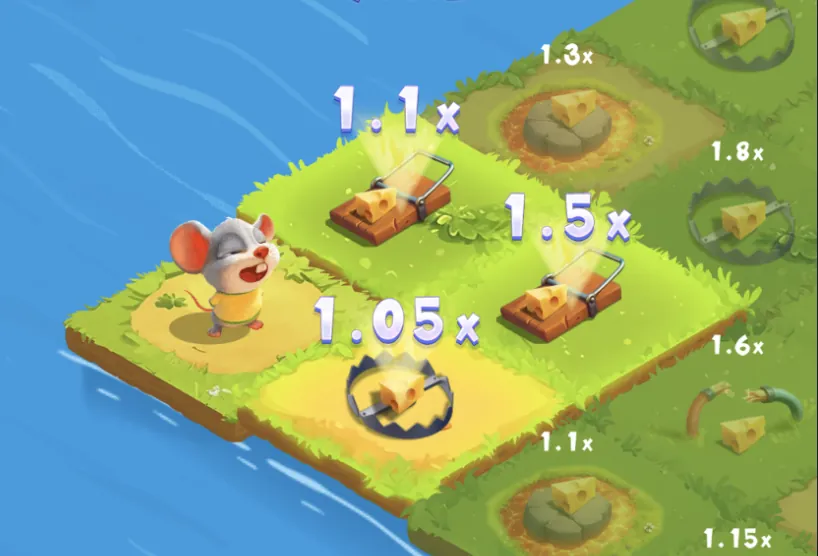
The Chees Road Game easy path (bottom arrow) has the lowest trap density of all three paths. Chees Road Game easy-path multipliers per step are smaller — typically 1.05x and 1.1x tiles — but the survival rate per step is the highest SmartSoft Gaming offers.
I recommend cashing out Chees Road Game conservative rounds between 1.5x and 2x. The probability of surviving to 2x on the Chees Road Game easy path is significantly higher than surviving to 5x, because each additional step compounds trap risk. Cashing out at 1.8x on a $1 bet yields $0.80 profit — modest, but repeated consistently across 150+ rounds, the conservative approach keeps the Chees Road Game bankroll alive far longer than any other method.
Session Management
With a $50 Chees Road Game bankroll and $0.50 bets (1% of bankroll), the runway is 100 bets before going broke assuming every round loses. In practice, with the Chees Road Game easy path and early cash-outs at 1.5-2x, expected session length extends to 150-250 rounds depending on cash-out timing.
I set Chees Road Game session limits before every session: stop if up 30% or down 40%. With a $50 bankroll, that means stopping at $65 (take-profit) or $30 (stop-loss). These fixed limits prevent the two costliest patterns in Chees Road Game — chasing losses and giving back wins.
Strategy 2: The Balanced Approach
The balanced approach is my personal preferred Chees Road Game strategy for real-money play. The Chees Road Game balanced strategy alternates between easy and medium paths — targeting 3x-5x cash-outs without the bankroll destruction of full-aggressive play. The balanced method requires more active decision-making per round, producing 80-150 round sessions on a $100 bankroll.
Balanced Strategy Summary
- Path selection: Start with easy, switch to medium after 2-3 safe steps
- Cash-out target: 3x to 5x your bet
- Bet sizing: 1% of your session bankroll
- Session goal: Moderate session length with occasional meaningful wins
- Best for: Experienced players, medium bankrolls, players who enjoy decision-making
The Switching Logic
In practice, I start every Chees Road Game balanced round on the easy path. The first 2-3 easy steps build a small multiplier cushion — from 1x up to about 1.3x-1.5x. After reaching that base, I switch the Chees Road Game path selection to medium. The Chees Road Game medium path offers 1.2x-1.5x multiplier tiles per step but increases trap density compared to easy.
The Chees Road Game balanced rationale: losing on the easy steps costs only the base bet, while surviving the medium steps builds multipliers 2-3x faster than easy-only play. The initial Chees Road Game easy steps are not about protecting winnings — the easy steps are about getting the multiplier high enough that medium-path risks become worth taking.
The balanced Chees Road Game approach still loses money over time due to the ~4% house edge. The difference from conservative play is that balanced wins at 3x-5x feel meaningful — a $1 Chees Road Game bet returning $4 is noticeable compared to a $1.50 conservative return. SmartSoft Gaming's RTP remains identical regardless of path choice.
When to Cash Out
My Chees Road Game balanced cash-out rule: once the multiplier hits 3x, I seriously consider cashing out. If the Chees Road Game board looks clear, I might push to 4x or 5x. I never push past 5x with the balanced strategy — the probability of surviving to 6x-7x on the Chees Road Game medium path drops steeply, and the extra multiplier does not compensate for the increased bust probability.
The hardest part of the Chees Road Game balanced strategy is discipline, not math. At 4.5x with a clear-looking board, every instinct pushes for "one more step." That is when players must remember: the next Chees Road Game tile has the exact same trap probability as every other tile at that difficulty level. SmartSoft Gaming's provably fair system does not adjust trap density based on current multiplier.
Strategy 3: The Aggressive Approach
The aggressive Chees Road Game strategy burns through bankroll fast — typically 40-80 rounds on a $200 bankroll with $0.50 bets. I include the aggressive approach because some Chees Road Game players have the risk tolerance and bankroll for high-variance play. Players with limited bankrolls (under $200 for $1 bets) should skip the aggressive strategy entirely.
High Risk Warning
The Chees Road Game aggressive approach has the highest variance of any strategy on this page. Approximately 60-70% of aggressive rounds end in a loss within the first 3 steps. The Chees Road Game expected loss rate remains ~4% per dollar wagered, but session swings are extreme. Only consider aggressive play with a bankroll of $200+ that you are genuinely comfortable losing entirely.
Aggressive Strategy Summary
- Path selection: Hard (middle arrow) from step one
- Cash-out target: 10x or higher
- Bet sizing: 0.5% of your session bankroll (smaller due to high bust rate)
- Session goal: Land a few large wins that offset many losses
- Best for: Large bankrolls, high risk tolerance, players seeking excitement
The Reality of High-Variance Play
The Chees Road Game hard path (middle arrow) delivers the biggest multiplier tiles — 1.5x, 1.8x, and higher per step. The Chees Road Game hard path also carries the highest trap density, including mousetraps (4x), cat boxes (5x), lava pits (3.5x), and slingshot traps (50x — the most dangerous obstacle in Chees Road Game).
In my Chees Road Game hard-path testing, roughly 60-70% of rounds end within the first 3 steps. The remaining 30-40% of rounds where the mouse survives past step 3 build multipliers rapidly — sometimes reaching 5x, 8x, or 15x. The Chees Road Game aggressive math requires those rare big wins to offset the frequent early busts.
Practical Chees Road Game aggressive example: $0.50 bets across 100 hard-path rounds might produce 65 losses ($32.50 lost) and 35 wins averaging 4x ($70 returned) — a net of +$37.50. However, Chees Road Game variance means actual results could range from -$40 to +$100. Over thousands of rounds, SmartSoft Gaming's ~4% house edge pulls all results toward a 4% loss regardless of path choice.
When Aggressive Play Makes Sense
Aggressive Chees Road Game play is defensible only when the entertainment goal is specifically the thrill of large multipliers. If watching a Chees Road Game multiplier climb past 10x is the primary enjoyment, the aggressive approach delivers that experience — at the cost of 40-80 round sessions and $200+ bankroll requirements.
I never recommend switching to aggressive Chees Road Game play to "recover" losses from conservative or balanced sessions. The Chees Road Game house edge of ~4% does not adjust based on player emotional state, and desperation bets are the fastest way to deplete a bankroll. SmartSoft Gaming's algorithm treats every round identically regardless of prior results.
Strategy Comparison at a Glance
| Factor | Conservative | Balanced | Aggressive |
|---|---|---|---|
| Path Choice | Easy only | Easy + Medium | Hard only |
| Cash-Out Target | 1.5x - 2x | 3x - 5x | 10x+ |
| Bet Size (% of bankroll) | 0.5% - 1% | 1% | 0.5% |
| Estimated Win Rate | ~70-80% | ~40-55% | ~20-35% |
| Average Win Size | Small (1.5-2x) | Medium (3-5x) | Large (10x+) |
| Session Length | Long (150-250 rounds) | Medium (80-150 rounds) | Short (40-80 rounds) |
| Bankroll Needed ($1 bets) | $50+ | $100+ | $200+ |
| Emotional Experience | Steady, calm | Engaging, varied | Thrilling, volatile |
| House Edge | ~4% | ~4% | ~4% |
Note: Win rate estimates are approximate and based on typical cash-out targets for each strategy. The house edge remains constant at ~4% regardless of strategy. All numbers assume optimal cash-out discipline.
Game-Specific Tactics for Chees Road Game
Beyond the three core strategies, Chees Road Game has four mechanics — Ghost Mode, board reading, trap types, and manual cash-out — that inform in-game decisions. These Chees Road Game tactics are observations about SmartSoft Gaming's design, not exploits. The ~4% house edge remains constant regardless of tactical play.
Ghost Mode Timing
Ghost Mode is Chees Road Game's signature power-up by SmartSoft Gaming. When Ghost Mode activates, the mouse turns into a blue transparent ghost that passes through one trap safely. The key insight: Ghost Mode's value is proportional to the current Chees Road Game multiplier.
Ghost Mode at 1.2x saves $0.20 on a $1 Chees Road Game bet. Ghost Mode at 8x saves $7.00. I use Ghost Mode activation as a signal to push 1-2 extra steps beyond my normal Chees Road Game cash-out target — but only above 3x. Ghost Mode protection at 1.1x wastes the power-up's highest value, though players cannot control when Ghost Mode appears.
Board Reading
Chees Road Game allows players to zoom out and view the entire board before making moves. SmartSoft Gaming's provably fair system predetermines trap positions — the board view cannot reveal trap locations, but the board view does show step count and tile layout for each Chees Road Game path.
I use the Chees Road Game full board view to count remaining steps on each path before choosing easy, medium, or hard. On mobile, pinch to zoom out at the start of every Chees Road Game round. Board reading does not change underlying probabilities, but board reading replaces impulsive clicking with deliberate Chees Road Game path decisions.
Trap Awareness
Each of the five Chees Road Game trap types carries a specific multiplier and distinct risk profile. Understanding Chees Road Game trap types helps players contextualize losses and manage expectations on each difficulty path.
- Mousetrap (4x): Common on easy and medium paths. Standard risk.
- Cat Box (5x): Slightly rarer. Appears more on medium paths.
- Lava Pit (3.5x): Visual cue is a volcanic hole. Common across all paths.
- Slingshot (50x): Rare but devastating. Mostly on hard paths. The 50x multiplier attached to this trap is why hard paths offer such high rewards.
- Bear Trap (2x): The lowest-risk trap. Frequent on easy paths but relatively harmless in terms of multiplier loss.
Cash-Out Discipline
Chees Road Game has no auto-cashout feature — SmartSoft Gaming designed every Chees Road Game cash-out decision to be manual. Manual cash-out gives players full control but provides no safety net for impulsive decisions.
My strongest Chees Road Game recommendation: decide the cash-out target before the round starts and stick to the target. When I play Chees Road Game with the balanced approach, I set "cash out at 3.5x" before clicking the first arrow. If the Chees Road Game multiplier hits 3.5x, I cash out immediately — no hesitation, no "one more step." The Chees Road Game rounds where I have lost the most money are always rounds where I changed the plan mid-round.
Bankroll Management for Chees Road Game
Bankroll management is the single most impactful section of this Chees Road Game guide. Bankroll management will not help any player hit the 10,000x maximum multiplier. Bankroll management is the difference between walking away from a Chees Road Game session able to play tomorrow and depleting an entire month's entertainment budget in one frustrated evening.
The 1% Rule
Never bet more than 1% of your Chees Road Game session bankroll on a single round. A $100 Chees Road Game bankroll means a $1 maximum bet. A $50 bankroll means a $0.50 cap. The 1% rule is based on the mathematics of ruin: in any negative-EV game like Chees Road Game (~4% house edge), the percentage risked per bet directly determines how fast the bankroll depletes.
At 1% per Chees Road Game bet, a losing streak of 50+ rounds still leaves more than half the bankroll intact. At 5% per bet, 20 consecutive Chees Road Game losses (not unusual on the hard path) wipe out 64% of the bankroll. At 10% per bet, the Chees Road Game session essentially becomes a coin flip with the entire bankroll every few minutes.
Bankroll Allocation
Your active session funds. Bet 1% of this per round maximum. This is the money you're actively risking.
Set aside and don't touch during the session. This prevents you from chasing losses with your full deposit.
Cash this out immediately after depositing. Guarantees you leave with something regardless of session results.
Session Limits
I set three non-negotiable limits before every Chees Road Game session. These Chees Road Game session limits, verified through my testing since 2019, prevent the most common bankroll destruction patterns:
Stop-Loss
If your playing bankroll drops to 60% of its starting value, stop. Period. With a $100 playing bankroll, you stop at $60. No exceptions, no "one more round to get it back." This single rule prevents the most common bankroll destruction pattern.
Take-Profit
If your playing bankroll reaches 130% of its starting value, cash out at least the profit and consider stopping. With $100, cash out when you hit $130. It's psychologically harder to stop when winning, but winners who can't stop become losers.
Time Limit
Set a timer for 45-60 minutes. When it goes off, stop regardless of where you stand. Extended sessions lead to fatigue, which leads to bad decisions. I've never regretted ending a session on time, but I've regretted extending one many times.
Practical Example
Here's exactly how I'd set up a Chees Road Game session with a $200 budget using the balanced strategy:
Session Setup Example
Total deposit: $200
Walk-away fund (5%): $10 — cash out immediately, guarantee you leave with this
Reserve (15%): $30 — don't touch during session
Playing bankroll (80%): $160
Bet size (1%): $1.60 per round (round to $1.50 for convenience)
Stop-loss: Stop at $96 playing bankroll (60% of $160)
Take-profit: Cash out profits at $208 playing bankroll (130% of $160)
Time limit: 50 minutes
Cash-out target: 3.5x per round (balanced strategy)
Myth Busting: What Doesn't Work in Chees Road Game
Many Chees Road Game "strategies" circulating online contradict SmartSoft Gaming's provably fair algorithm and basic probability theory. I address the five most common Chees Road Game myths below because believing false strategies costs real money.
Myth: "I'm Due for a Win"
The gambler's fallacy is the single most expensive belief in Chees Road Game. After losing 8 rounds in a row, the probability of winning Chees Road Game round 9 is exactly the same as Chees Road Game round 1. SmartSoft Gaming's provably fair system generates each Chees Road Game outcome independently using SHA-256 cryptographic hashing.
Five consecutive Chees Road Game losses feel like a pattern that must reverse. The pattern is an illusion. SmartSoft Gaming's algorithm has no memory of prior Chees Road Game rounds. The only thing "due" after a Chees Road Game losing streak is more independent randomness.
Myth: "The Martingale System Works"
The Martingale system — doubling the bet after every loss — is mathematically guaranteed to fail in Chees Road Game. Chees Road Game has a maximum bet of $100. Starting from $0.10, Martingale hits the $100 Chees Road Game bet cap after just 10 consecutive losses ($0.10, $0.20, $0.40... $51.20, $102.40). At that point, the total Martingale loss is $102.30 with no way to double further.
Even without the Chees Road Game bet cap, Martingale does not change expected value. The Martingale system converts many small wins into rare catastrophic losses. Martingale feels effective until the one catastrophic loss that wipes out all previous Chees Road Game gains plus more.
Myth: "Hot and Cold Streaks Are Real"
In Chees Road Game's provably fair system by SmartSoft Gaming, hot and cold streaks have zero predictive value. Players will experience clusters of wins and clusters of losses — clustering is what true randomness looks like. However, a Chees Road Game win cluster does not predict the next outcome.
SmartSoft Gaming's Chees Road Game algorithm has no memory between rounds. Past Chees Road Game outcomes — whether 5 wins or 5 losses in a row — have zero predictive value for the next round. Each Chees Road Game round is generated independently via cryptographic hashing.
Myth: "Playing at Certain Times Helps"
Claims that Chees Road Game pays out more during off-peak hours or after server resets are completely false. SmartSoft Gaming's provably fair algorithm generates each Chees Road Game outcome independently of server load, time of day, or number of active players. The Chees Road Game RTP of ~96% does not vary by time of day or player count.
Anyone claiming "play Chees Road Game at 3 AM for better odds" either got lucky once and drew the wrong conclusion, or is trying to sell a false system. SmartSoft Gaming's Curacao-licensed algorithm does not adjust Chees Road Game RTP based on when players connect.
Myth: "Betting Systems Create an Edge"
No betting system — Martingale, Fibonacci, D'Alembert, Labouchere, or any variation — creates a mathematical edge in Chees Road Game. All betting systems rearrange bet sizes in different patterns, but every individual Chees Road Game bet carries a negative expected value of approximately -4%. Rearranging negative-EV Chees Road Game bets cannot produce a positive-EV outcome.
Each Chees Road Game bet carries SmartSoft Gaming's ~4% house edge regardless of the previous round's result or the bet size on the previous round. No arrangement of Chees Road Game bets changes the mathematical edge built into the provably fair algorithm.
Betting systems can change the Chees Road Game risk profile and session experience. Martingale produces many small wins and rare catastrophic losses. Reverse Martingale produces many small losses and rare large wins. Neither system changes the Chees Road Game expected outcome — the systems only reshape the session's volatility curve.
The Only Honest "Strategy"
Set a budget you can afford to lose. Choose a volatility level that matches your entertainment preference. Set session limits and honor them. Cash out when you hit your target. Accept that the house edge means you'll lose money over time. Play for entertainment, not income. That's the entire strategy, and it's the only honest one.
Where to Practice These Strategies
I recommend testing any Chees Road Game strategy in demo mode first. When ready for real money, 1Win is the partner I use personally for Chees Road Game — Curacao eGaming licensed, 15-60 minute withdrawals, and the highest current welcome offer at 500% across the first 4 deposits. Verified by Chees Road Editorial Team on April 3, 2026.
Frequently Asked Questions About Chees Road Game Strategies
There's no single "best" strategy because no approach can overcome the ~4% house edge. The most effective strategy depends on your goals. If you want long sessions with smaller swings, the conservative approach (easy path, 1.5-2x cash-outs) works well. If you want a balance of excitement and session length, try the balanced approach (easy/medium mix, 3-5x targets). The aggressive approach (hard path, 10x+ targets) suits players with large bankrolls who enjoy high-variance play. What matters most is disciplined bankroll management, not the specific path you choose.
No. The house edge of approximately 4% is a mathematical certainty built into the game's algorithm by SmartSoft Gaming. No betting pattern, timing strategy, or system can change this. Over enough rounds, you'll lose about 4 cents per dollar wagered. Strategies help manage your experience — how long you play, how volatile your sessions are, and how you handle wins and losses — but they don't change the underlying expected value. Anyone claiming otherwise is misleading you.
No. The Martingale system (doubling your bet after each loss) doesn't change expected value in Chees Road Game. It converts frequent small wins into rare catastrophic losses. With a max bet of $100 and a starting bet of $0.10, you hit the bet ceiling after just 10 consecutive losses — and you'll have lost over $100 with no way to recover using the system. Every round is mathematically independent; the game doesn't owe you a win after losses, and doubling your bet doesn't change the probability of winning the next round.
Ghost Mode lets your mouse pass through one trap safely, and its value depends entirely on when it activates. The optimal moment is when your accumulated multiplier is already significant — 5x or above. At that point, Ghost Mode is protecting real accumulated value. If Ghost Mode appears early in your round (at 1.1x or 1.2x), it's still useful but less impactful since you haven't built much value yet. You can't control when Ghost Mode appears, but when it does, consider pushing 1-2 extra steps beyond your normal cash-out target to capitalize on the protection.
A safe guideline is 100x your average bet size for a session bankroll. For $0.10 bets (the minimum), that's $10. For $1 bets, aim for $100. For $5 bets, $500. The 1% rule (never betting more than 1% of your bankroll per round) protects against the inevitable losing streaks that come with any gambling game. Aggressive players should consider 200x their bet size since the hard path has higher bust rates. Also remember: your gambling bankroll should be money you can genuinely afford to lose without any financial impact on your life.
Optimistic Strategy Outlook
Chees Road Game has an encouraging strategic shape because the core choices are easy to explain and easy to practice. The SmartSoft road, visible multiplier growth, trap risk, easy/medium/hard paths, and Ghost Mode all create a clear decision sequence: choose the risk path, set a cash-out target, keep the bet small, and stop when the written limit says the session is over. That kind of clarity helps players avoid the worst habit in instant-win games, which is inventing a new plan after every result. Even though the RTP and house edge remain fixed, a prepared player can make the session feel steadier and less emotional.
The optimistic approach is to use Chees Road as a controlled entertainment loop. Demo rounds can teach how quickly multipliers rise, while real-money rounds should stay small enough that one trap does not change the whole mood. Ghost Mode, early cash-outs, and route selection are most useful when they support the bankroll plan already chosen before play began.