
How to Play Cheesy Road
A practical SmartSoft rules guide for the mouse-and-cheese path game: choose a route, build multipliers, avoid traps, and cash out before the board turns against you.
What the official Cheesy Road rules confirm
Short answer
Cheesy Road is a SmartSoft single-player mine-style game: choose a bet, pick a route, move along a multiplier path, and cash out before a trap ends the round.
Confirmed mechanics
SmartSoft confirms easy, medium, and difficult route choices, cash-out, short-round gameplay, clear mechanics, and multipliers up to x10000.
Operator-rule facts
RTP, real-money bet range, payout cap, fairness details, and regional availability should be checked inside the live rules panel before depositing.
Official source for the route and cash-out rules used here: SmartSoft Gaming Cheesy Road page.
What the interface screenshots show
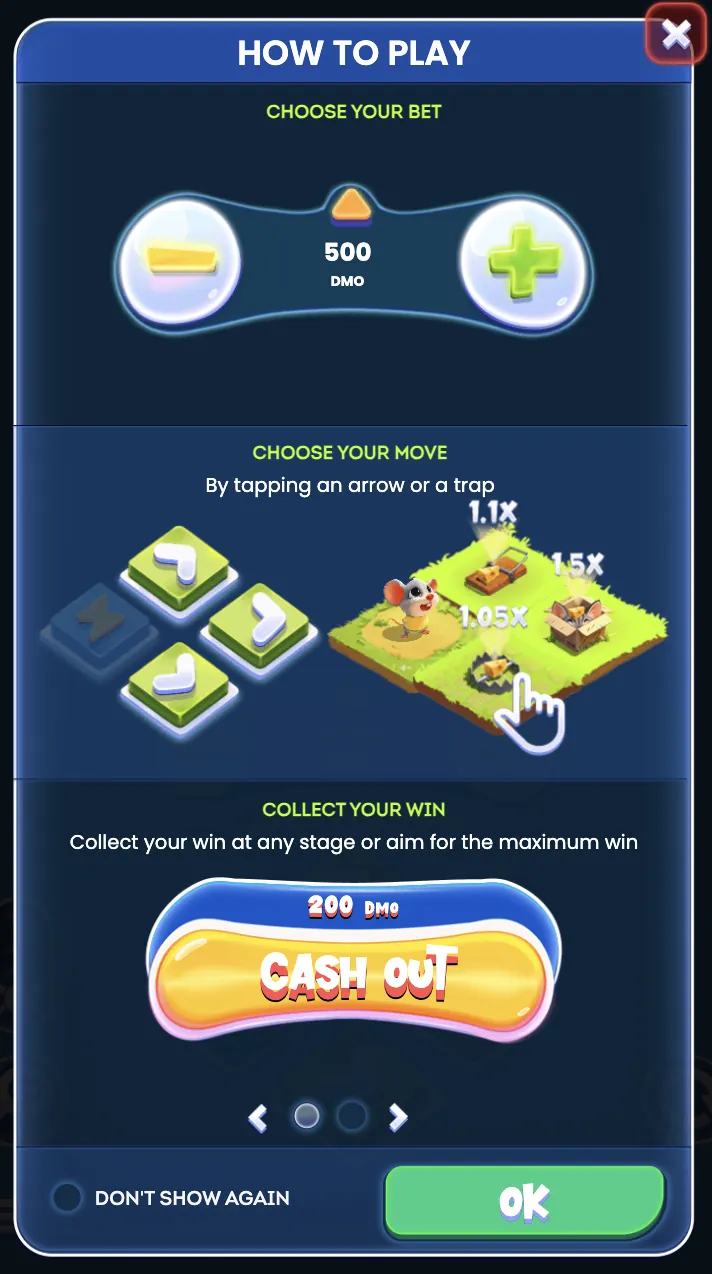
SmartSoft's official specification gives this page its rule base: choose a bet, press an arrow for your risk level, switch volatility at each step if you want, and cash out. Local screenshots add interface detail, including a 20,000 DMO balance, a 0.10 DMO bet, plus and minus controls, and the "Choose Your Way" prompt. That is enough to explain how a round feels without pretending that a screenshot proves live odds.
The game is built around short decisions. A player does not spin reels or wait through a long bonus animation. The useful action is the route choice: move ahead on the path, read the multiplier, then choose whether the next move is still worth the stake that is already exposed. Because each new move changes the emotional pressure, the page treats the interface as a decision tool rather than a decoration.
The name matters for search and for user confidence. SmartSoft lists the official title as Cheesy Road, while many players type Chees Road, Cheese Road, or Cheesy Road game. The site keeps the Chees Road brand where it already exists, but the content now connects that spelling to the confirmed SmartSoft title. That helps the page match real queries without losing the project's identity.
Bet Controls
The visible bet is in DMO, which is useful for demo guidance. Real-money minimum and maximum stakes should be taken from the operator rules, not from an old screenshot.
Route Buttons
Top is medium volatility, middle is difficult, and bottom is the easy road according to SmartSoft's specification. Confirm exact route math in the live rules.
Multiplier Tiles
Tiles show values such as 1.05x, 1.1x, 1.3x, 1.5x, and 1.8x. Screenshots support the interface explanation, while probability remains a rules-screen detail.

Chees Road round flow
Use demo rounds to learn the pace: choose a route, watch how the multiplier changes, and decide whether to cash out before a trap ends the board. The useful habit is deciding the stop point before the first move, not after a near miss. A planned cash-out target is not a prediction; it is a guardrail against moving the goal while the round is already tense.
A clean first round starts with one stake size. The player chooses a stake that would not create pressure if lost, checks the selected route, and makes the first move. After each safe tile, the multiplier is higher and the temptation to continue is stronger. That is the whole tension of Cheesy Road: the visible payout can grow, but the exposed stake is still at risk until cash out happens.
When explaining the round to a new player, keep the language plain. "Set bet" means choosing the amount at risk. "Choose route" means selecting one of the volatility paths. "Read tile" means checking the current multiplier after a move. "Cash out" means accepting the available win before another move. "Stop" means ending the session because the plan says so, not because the screen feels quiet.
How the three routes should be read
SmartSoft describes three directional choices: the top route is medium, the middle route is difficult, and the bottom route is the easy road. That wording is useful because it gives the page real game vocabulary. It should not be stretched into a promise that one route is safe, due, or predictable. A route label describes volatility, not a secret map.
Bottom Route
Use the bottom route when the goal is to learn the board and keep decisions calmer. It still carries loss risk, so it belongs in demo practice before real-money play.
Top Route
The top route sits between the other choices. It is a useful training path for players who already know where the cash-out button is and have a written stop point.
Middle Route
The middle route is described as difficult. Treat it as a high-pressure choice, not as an answer to a losing streak or a way to force a bigger result.
A player can switch volatility at every step, but that freedom is also where poor decisions happen. If the reason for switching is "I need the next result to fix the last one", the session has already left the plan. If the reason is "my cash-out target and stake plan allow this move", the choice is at least grounded in a rule made before the pressure rose.
Trap screens and risk language
Local images show several trap visuals, including mousetrap, cat, lava, slingshot, and caught-mouse screens. That gives the guide real visual substance; the exact trap probability, route math, and payout caps still belong to the current live rules. A trap screen is not just a loss result. It is a reminder that every uncashed multiplier is conditional.
The strongest SEO page is not the one that names every trap as if it has a fixed public probability. The stronger page separates what is visible from what is mathematical. A visible trap name helps a reader recognize the interface. A probability claim needs the current rules screen, version, operator, and jurisdiction. Without that support, it should stay out of the article.
Visible
Trap names and multiplier-style labels appear in local screenshots, which helps readers identify the interface state after a failed move.
Rules-Screen
Trap frequency, odds, and route-specific return should be checked where the operator publishes current game rules.
Player Check
Use the live rules panel before treating any trap label as a real-money rule, especially if a bonus or payout cap is involved.
Before real-money play
The safe order is source, rules, account, then stake. Source means confirming that the live lobby actually lists Cheesy Road by SmartSoft Gaming. Rules means opening the game information panel and checking RTP, max win, bet range, payout cap, and whether the route labels match what the page describes. Account means checking local legality, license information, KYC timing, payment ownership, and responsible-gaming tools. Stake means choosing a loss limit before the first real-money round.
Do not let a bonus headline replace this check. A bonus might have a max bet, excluded game list, reduced contribution for instant games, expiry window, withdrawal cap, or KYC condition. Any one of those can change whether playing Cheesy Road with a bonus is sensible. The bonus page on this site now treats codes as items to verify, not as fixed coupons.
- Confirm the game name in the live lobby. The screenshots show Cheesy Road branding.
- Confirm RTP, real-money max win, bet range, payout cap, and feature rules in the live rules screen.
- Check local legality, operator license, KYC rules, payment ownership, and responsible-gaming tools.
- Use demo mode first if it is available in your region, then decide whether real-money risk is still acceptable.
- Write the stop point before the session starts. If the stop point feels too strict during play, stop anyway and review later.
How to read a live rules panel
A good live rules check takes less time than a deposit dispute. Look for the provider name, the game title, the game version if shown, and the return information. Then check whether the operator adds its own limits, such as a maximum payout per round, maximum bet while using a bonus, or country-specific restrictions. If the rules panel uses unclear language, save a screenshot and ask support before playing with real funds.
When the rules differ from this guide, the live rules win. That is not a weakness in the content; it is the correct way to handle casino games that can be configured by operator, market, or platform. This page gives the reader the vocabulary to check Cheesy Road. It does not replace the account-level terms that control real money.
Game Identity
Title, provider, version, route names, and demo availability should match the game being opened.
Money Rules
RTP, bet range, max win, payout cap, currency, and bonus contribution need current operator confirmation.
Account Rules
KYC, withdrawal review, self-exclusion, country access, and payment ownership sit outside the game screen.
Example first-session plan
A first Cheesy Road session should feel almost boring on purpose. Open demo mode, choose the bottom route, set the smallest visible demo stake, and run five boards with a one-step cash-out target. Then repeat five boards with a two-step target. Do not judge the plan by the DMO balance. Judge it by whether the same stake, route, and stop point were respected without mid-round changes.
If that first demo pass feels rushed, repeat it before trying another route. If it feels controlled, open the live rules panel and read the money terms before any deposit. The first real-money session, if it happens at all, should be smaller than the amount that would create pressure. Its purpose is to confirm the account flow, not to chase the x10000 headline.
This also gives the guide a better editorial model. Instead of saying "play carefully" in a vague way, the page shows what careful means: a route chosen in advance, a stake that stays fixed, a target written before the move, and a stop that still applies after a lucky result. That is the behavior a reader can copy.
Common Cheesy Road misunderstandings
"Easy" Means Safe
The easy road is a lower-volatility label, not a guarantee. A trap can still end the round before cash out.
x10000 Is Typical
x10000 is a potential multiplier noted by SmartSoft, not a normal expectation for a session.
Demo Equals Real Money
Demo mode teaches the interface. It does not confirm live RTP, payout caps, KYC timing, or bonus rules.
Another common misunderstanding is treating screenshots as a permanent rulebook. Screenshots are helpful for recognizing buttons, route labels, and cash-out states, but they can become outdated. The operator's current rules panel controls real-money play. If a screenshot and live rules disagree, use the live rules and tell the editorial team so the page can be corrected.
Players also mix up provider facts and casino facts. SmartSoft can confirm the game title, route concept, demo availability, responsive play, and potential multiplier. A casino or operator controls account registration, currency, bonus eligibility, jurisdiction, deposit methods, withdrawal checks, and responsible-gaming tools. Good Cheesy Road content keeps those two layers separate.
A final misunderstanding is treating the x10000 ceiling as a session target. It is a potential multiplier, not a plan. A new player who builds every session around the highest visible number will usually ignore cash-out discipline. The better plan is to treat the ceiling as context and to treat the next cash-out decision as the real action.
Use the same logic when comparing guides in search results. A page that explains SmartSoft, routes, demo play, and operator checks is more useful than a page that promises secret steps. The useful guide reduces confusion before money is involved. It does not make the game safe.
There is also a timing misunderstanding. Because Cheesy Road rounds are short, a player may think a small session cannot become risky. The opposite can happen: short rounds allow more decisions in less time. That makes a written stop point more important, not less important. Count rounds as well as money. A ten-round demo routine teaches more than an open-ended session where the player only stops when tired.
Finally, remember that "how to play" is not the same as "when to play". The guide can explain the buttons, routes, multiplier path, trap result, and cash-out state. The decision to play for real money depends on age, local law, operator license, account limits, personal budget, and gambling health. If any of those checks feels uncomfortable, the correct move is to stay with free information and demo practice.
That distinction also helps the site keep its identity. Chees Road can remain a focused guide for a popular route game without pretending to be an operator, a bonus cashier, or a prediction system. The strongest how-to page tells readers exactly what action they can take next: learn the screen, check the live rules, decide a stake limit, and stop if the terms are not clear.
For returning readers, the practical order is the same every time. First, identify the game as Cheesy Road by SmartSoft Gaming. Second, use demo mode to refresh the controls. Third, open the operator rules and compare them with the guide. Fourth, decide whether the session limit still feels comfortable. If any step fails, the guide has already done its job by preventing a rushed deposit.
That repeatable order is also easier to maintain as the game, screenshots, and operator pages change.
It gives editors a stable checklist too: if a future update changes one part of the game, only that part needs revision. The page can keep the same user journey while replacing outdated details.
FAQ
It confirms SmartSoft's published route controls, cash-out flow, and multipliers up to x10000, plus interface details visible in local screenshots.
RTP, real-money bet limits, casino availability, and account-specific bonus rules are operator-side details that must be checked in the live rules screen.
No. Screenshots are useful for orientation, but the current live rules screen is the only place to confirm real-money terms.
Use demo mode and start with the bottom route, because SmartSoft describes it as the easy road. That does not make it risk-free; it only gives a calmer place to learn the controls.
SmartSoft says players can switch volatility at every step. Treat route switching as a planned choice, not as a reaction to a loss or a way to chase a larger multiplier.
The official source checked for this page confirms gameplay and x10000 multipliers, but not a fixed public RTP. RTP belongs in the current live rules panel.
Do not raise the next stake to recover. Mark the result as finished, compare it with the written session plan, and stop if the loss limit has been reached.